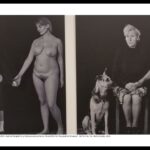
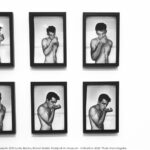
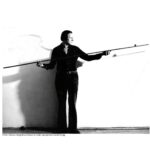
In July 1964, a book was published in Tokyo in an edition of just five hundred copies. Titled Grapefruit, it was written and published by Yoko Ono. Rather than stories, it contained more than 150 short instructions, some calling for action, others to be carried out entirely in the imagination. In one of them, Cloud Piece, written in the spring of 1963, Ono proposed imagining clouds dripping with water, then digging a hole in the garden and placing them inside.
The intention was not to create an object, or even to carry out the instruction. The thought itself was sufficient to lend an impossible event a surprising sense of reality. The garden, the earth, the clouds – all existed without anything having to be touched. What interested Ono was the experience that emerged between language and the reader’s imagination. A work could take place anywhere, without a gallery, materials or the artist’s presence.
In 1965, Ono conceived another work, Light House – a house made entirely of light. She imagined it as a kind of spectral architecture that would appear and disappear, just as the sun does not shine every day. Two years later, John Lennon invited her to Kenwood, his home in England, and asked whether such a house of light could be built in his garden. Recalling the conversation, Ono acknowledged that for her the project had remained an idea, whereas Lennon could imagine it taking physical form.
It would take forty years for the idea to be realised.
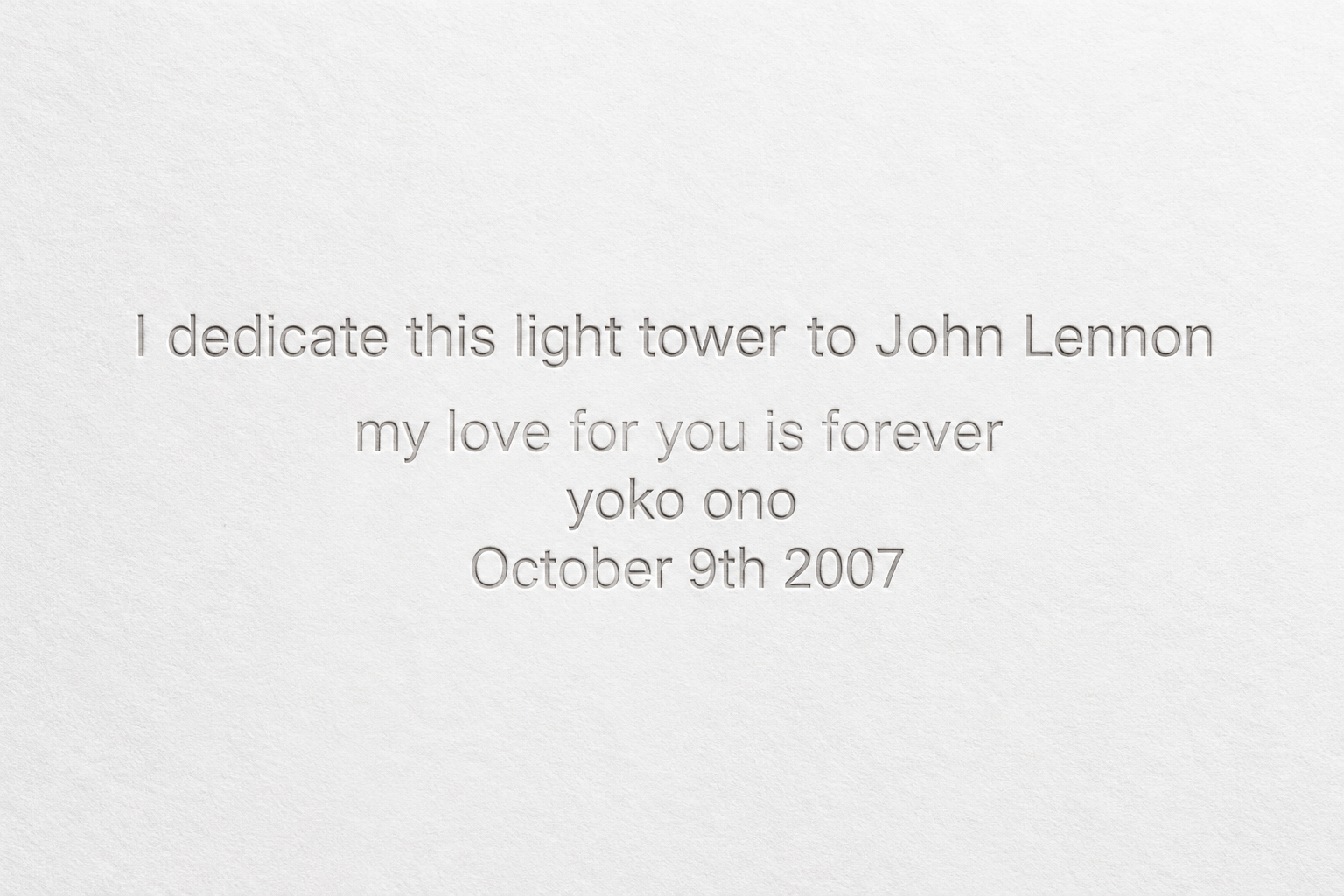
On 9 October 2007, what would have been John Lennon’s sixty-seventh birthday, Imagine Peace Tower was unveiled on Viðey, an Icelandic island in Kollafjörður Bay. Dedicated to the musician’s memory and his commitment to peace, the installation also gave physical form to an artistic concept conceived before the two had met.
From a distance, only a vertical column of light is visible. Its source, however, lies close to the ground, within a stone wishing well. The words “Imagine Peace” are inscribed in twenty-four languages on the white wall surrounding the structure. The installation stands on a platform covered with three types of Icelandic rock: rhyolite, dolerite and basalt. The austerity of the stone contrasts with the immaterial nature of the work, whose true height remains undefined.
Behind this apparent simplicity lies a carefully engineered optical system. Fifteen beams converge into a single column, six of them initially travelling horizontally through passages within the platform. A system of mirrors then directs them upwards into the sky. The light has neither a fixed shape nor a constant intensity. Its visibility depends on humidity, fog, rain and snow. Icelandic weather, ordinarily regarded as an obstacle to viewing art outdoors, becomes an integral part of the work’s appearance. On a cloudless night, the tower forms a distinct column of light. In rain and snow, the beams shimmer with rainbow refractions; when clouds gather, they illuminate the shifting layers above and are reflected back from them.
The installation is powered by geothermal energy from the Hellisheiði power plant. The choice of Iceland was deliberate. Ono pointed to the country’s use of renewable natural resources and its particular relationship with the energy of the earth. In a project whose primary material is light, the means of producing it was also significant.
The structure on Viðey recalls the biblical Tower of Babel. According to the Book of Genesis, people speaking a single language sought to build a tower reaching the heavens. Their collective undertaking ended in the confusion of languages and their dispersal. Yoko Ono reverses this order. At the base of her tower are twenty-four languages, yet all convey the same thought. Diversity does not lead to misunderstanding; instead, it allows a single wish to be expressed in many ways. Where the biblical builders laid bricks, Ono works with light. She does not attempt to reach the heavens with a material structure. She allows the beams to dissolve freely into the sky.
There is another, less visible dimension to the project. At the foot of the tower lie wishes sent from around the world, collected through Wish Tree, a project Ono has developed since 1996. Its premise is simple. A tree of a species chosen for its particular location is placed in a museum, gallery or garden. Visitors write their wishes on small slips of paper, fold them and tie them to its branches. Over time, the tree’s canopy fills with thousands of paper messages.
The wishes are later sent to Ono, who says she does not read them. She considers them personal and does not wish to intrude upon the privacy of those who wrote them. The slips are placed in special capsules and buried in the ground surrounding Imagine Peace Tower. Nearly a million wishes have been gathered there. Unknown names, different alphabets, hopes expressed in solitude or in the presence of others. Their contents remain hidden, yet all become part of a public work of art.
Here, the story comes full circle. In Cloud Piece of 1963, Ono proposed digging a hole in which imagined clouds might be kept. On Viðey, the earth does indeed hold something immaterial: human desires, hopes and visions of the future. Above them rises the light. What remained a poetic instruction in a small book published in Tokyo has, decades later, taken the form of architecture shaped by the participation of people from many countries.
Imagine Peace Tower is also among the few monuments whose presence is intermittent. The installation is illuminated each year on 9 October, Lennon’s birthday, and remains lit until 8 December, the anniversary of his death. It returns from 21 to 31 December, then on 18 February, Ono’s birthday, and around the spring equinox, from 20 to 27 March. For the rest of the year, the island usually remains dark.
Speaking to the Associated Press before the installation was unveiled in 2007, Yoko Ono explained that its limited annual period of illumination was intended to evoke the brevity of human life, while light itself remains eternal. This juxtaposition of transience and continuity encompasses both the memory of Lennon and Ono’s conviction that imagination can give tangible form to what initially exists only in the mind. The light rising above Viðey is therefore not merely a symbol of remembrance, but also a reminder that peace remains possible – an idea whose realisation still depends on people.
━━━━━━━━━━━━━━━━━━━
The annual illumination of Imagine Peace Tower is accompanied by events organised in collaboration with the City of Reykjavík, Reykjavík Art Museum and Reykjavík City Museum. Yoko Ono supports the celebrations by offering free ferry crossings to Viðey, enabling residents and visitors to take part in the event.
If you found this article valuable and would like O Zmierzchu i Świcie to continue publishing independent editorial content, you can support the Magazine Development Fund.
For more information, visit ABOUT THE MAGAZINE .
Content published in O Zmierzchu i Świcie is intended for educational and general informational purposes. It does not constitute medical, psychological or nutritional advice and is not a substitute for consultation with a physician or another qualified professional.