



A DEEPER ORDER
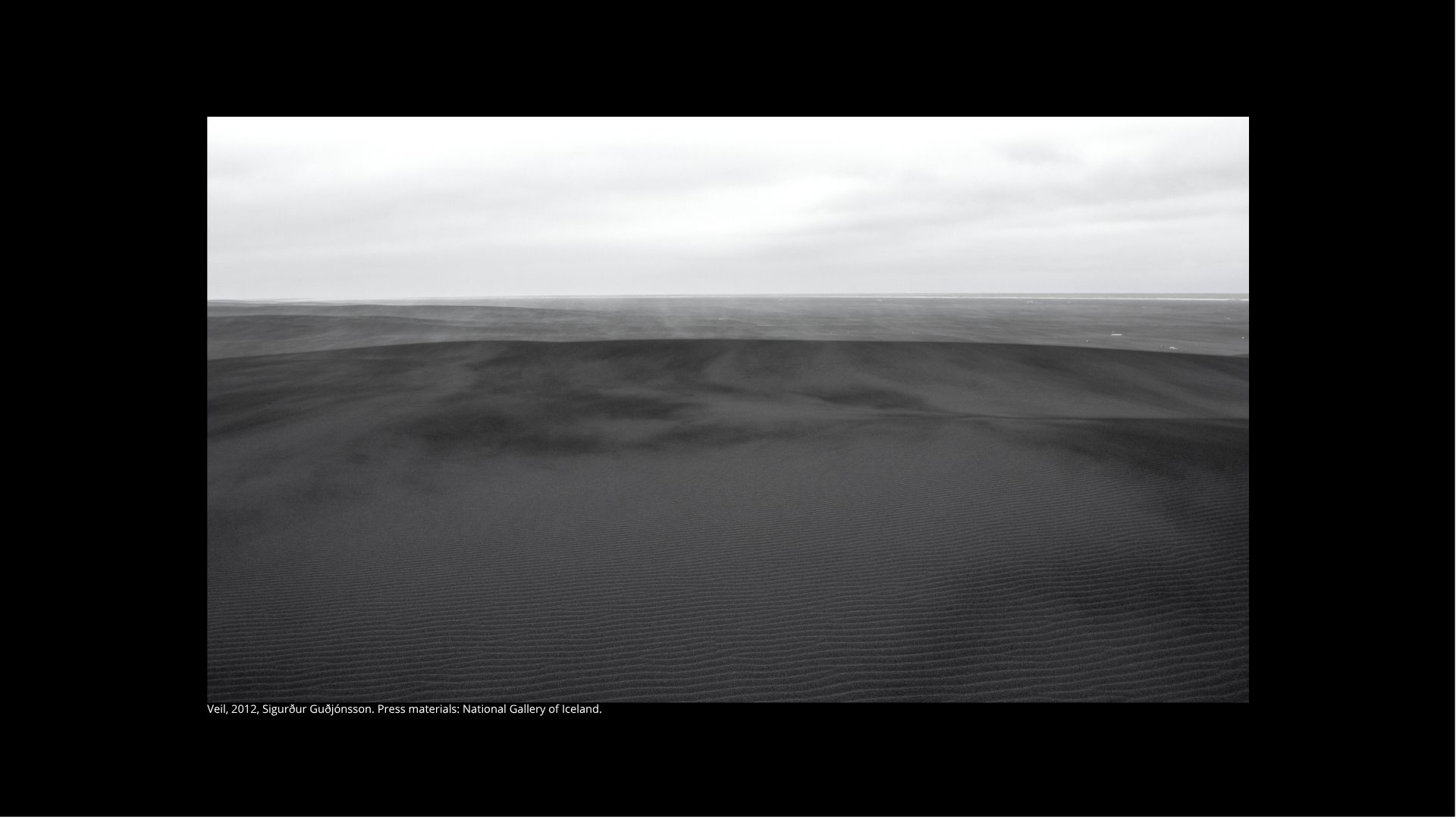
The camera remains still. Before it lies the black expanse of Skeiðarársandur, yet the landscape is never quite the same from one moment to the next. Wind carries fine grains of sand across the surface, lifting, concentrating, and dispersing them. Black gives way in places to areas of near white. Streaks and forms resembling imprints appear, then disappear, replaced by others. There are no cuts and no changes in perspective. Sigurður Guðjónsson’s Veil was filmed as a single uninterrupted take lasting sixty minutes.
The longer the projection continues, the more becomes visible within the landscape. The image begins to take on a rhythm of its own. Wind is the driving force, but sand is at the center. Individual grains move, collide, disappear into the larger mass, then become visible again. The dynamics are constantly shifting. At times the movement grows more forceful, almost monumental, before giving way to quieter, lighter passages. All are part of the same phenomenon.
A particular tension emerges in Veil. What appears visually light, almost weightless, also carries a palpable weight. The sand moves like fabric, yet remains matter. Beneath this movement lies a rippled surface whose parallel lines retain their shape. Above it, successive layers of sand rise and dissolve, as though the energy of the wind were passing just above a fixed structure. Density, tone, and intensity shift, while the pattern of lines below remains discernible. Stability and change coexist within the same image.
Sound plays a crucial role. It is intense and powerful, but never dominant. It gives what unfolds before the camera a dimension that the image alone cannot convey. The image can be observed from a distance; sound reduces that distance. At a certain point, it becomes difficult to experience Veil simply as a record of an event. The large scale projection draws the viewer into an experience shaped by image, sound, and time.
Sustained attention reveals the direction and intensity of movement, the density of matter, its texture and tonal transitions, and how much unfolds within what first appears to be a single, continuous phenomenon.
Out of this constant change, an order emerges.
Recognizing it takes time. Attention stops anticipating the next event and begins to follow the process itself. Observation takes on a hypnotic, almost meditative quality, and the boundary between looking and participating begins to blur. Perception no longer follows a single point within the frame. Instead, it moves with the phenomenon itself, following the movement of the wind one moment and the resistance of matter the next, until the two can no longer be clearly separated.
The continuous loop of Veil is equally important. It reinforces the sense of a process that moves toward no resolution. Each successive configuration gives way to another without ever settling into a final form. The National Gallery of Iceland interprets this structure in relation to the inexorable passage of time.
Guðjónsson has spoken about wanting to create a mental space for the viewer, one in which it becomes possible to move beyond the ordinary flow of consciousness and allow the mind to wander freely. The sixty minute duration of the take and its sustained focus on a single phenomenon create the conditions for such an experience.
Skeiðarársandur, then, is not merely a backdrop for the film. The wind moving grains of black sand is the event itself. The National Gallery of Iceland also draws attention to the phenomenon of aeolian transport, the movement of sand and dust by wind. Guðjónsson does not construct this process. He simply places the camera before it and lets it unfold.
This close attention to matter continues in Guðjónsson’s later works. Enigma (2019) examines matter under an electron microscope, Fluorescent (2021) takes the camera inside a fluorescent tube, and Perpetual Motion, presented at the Venice Biennale in 2022, turns to magnified metallic dust. Veil, however, requires no microscope, apparatus, or enclosed system. The matter and the forces that transform it are already present in the landscape of Skeiðarársandur.
The National Gallery of Iceland acquired Veil in 2015. In its current presentation, the image occupies nearly the entire field of vision. Grains and layers of matter take on a monumental scale, while sound gives their movement a physical presence.
Guðjónsson neither directs the image toward a resolution nor confines it to a single meaning. He lets the image run its course. Within the continuous movement of matter, nothing appears accidental. What initially seems elusive gradually reveals a logic of its own. A deeper order.
━━━━━━━━━━━━━━━━━━━━
If you found this article valuable and would like O Zmierzchu i Świcie to continue publishing independent editorial content, you can support the Magazine Development Fund.
For more information, visit ABOUT THE MAGAZINE .
Content published in O Zmierzchu i Świcie is intended for educational and general informational purposes. It does not constitute medical, psychological or nutritional advice and is not a substitute for consultation with a physician or another qualified professional.