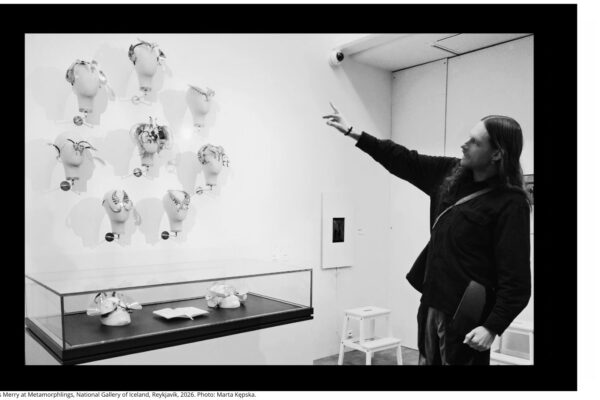
During a guided tour of Leaky Bodies, Shared Worlds: Works from the Bunkier Sztuki Collection in Kraków at Reykjavík Art Museum – Hafnarhús, a member of the audience remarked that forests and deer seem exotic to Icelanders. The conversation took place in front of a work by Bartosz Kokosiński.
The exhibition brings together works by thirty artists from the collection of Bunkier Sztuki in Kraków, spread across two floors of Hafnarhús. Curators Agnieszka Sachar and Aldís Snorradóttir begin with the human body – biologically vulnerable, subject to social expectations, technological intervention and ongoing attempts to control it. As the exhibition unfolds, its focus shifts from the boundaries of the body to humanity’s relationship with the environment: a world we reshape and exploit, yet depend on for our survival. Nature appears both as something subjected to violence and as a force that can transform human structures, become part of the creative process or offer relief to overstimulated senses.
The idea of leakiness in the exhibition’s title suggests that the body cannot be separated from the conditions in which it exists. We do not end at the surface of our skin. Our lives are shaped by the environment, history, technology and social relationships. In Reykjavík, this takes on another dimension: cultural displacement. The Polish collection is being shown in a country where Poles make up the largest immigrant community.
During the discussion with Marta Antoniak, Bartosz Kokosiński and Michał Zawada, the conversation repeatedly moved beyond the artists’ intentions. Questions from the audience prompted associations and experiences that could not be read from the works alone.
Traces
In her installation Archives a and Archives abc, Marta Antoniak arranged ceramic piggy banks, plastic toys and small objects coated in paint and artificial crystals inside old wooden printers’ drawers. Irregular formations spread across their surfaces, blurring the distinction between manufactured objects and forms that resemble living organisms. Each compartment looks like a fragment of a collection whose original order has become impossible to decipher.
It is an archive with a peculiar chronology. It contains traces of the past, yet looks as though it were discovered after the collapse of the civilisation that produced it. Contemporary waste takes on the appearance of artefacts from an unknown era. Antoniak spoke of imagining the past and the future at the same time.
Among the objects are figurines from Kinder Surprise eggs. For children growing up in Poland in the 1990s, they were coveted possessions, colourful signs of a market opening up to the West. Beside them, ceramic piggy banks from before Poland’s political and economic transformation seem to belong to a different aesthetic world. Antoniak recalled the browns and greys that dominated the earlier period, contrasting them with the bright colours of Western toys.
A toy, however, carries no memory of its own time. It is the viewer who sees in it childhood longing, the family home or a moment of historical change. Without that knowledge, the figurine is simply a small plastic object, its cultural history inaccessible. Looking at the Icelandic landscape, Antoniak herself noticed an unexpected resemblance between the growths and formations in her installation and the island’s natural environment.
Landscape
Bartosz Kokosiński’s practice is rooted in painting, although the work shown at Hafnarhús occupies physical space rather than remaining confined to a canvas. A wooden structure, animal trophies and elements associated with traditional depictions of nature come together in an object that breaks the painted landscape down into its material components.
The tension lies between what the image depicts and what it is made of. The animal appears both as a subject of representation and as a physical part of the composition. Wood draws attention to the material reality of the landscape that painting turns into a view. Kokosiński explores the limits of painting itself, drawing on its conventions while challenging their familiar forms.
Asked about his choice of animals, the artist described how he had gradually collected the objects, drawn to their individual characteristics. He was interested in the particular shapes and expressions of the trophies rather than in systematically representing different species.
The conversation also turned to paintings of forest landscapes that hung in Icelandic homes during the 1960s and 1970s. They depicted a natural world unfamiliar to the island’s inhabitants from their own surroundings.
A forest in a painting could become a familiar sight inside an Icelandic home, even though no road in the surrounding landscape led there.
Boundary
In Michał Zawada’s paintings, landscape becomes a way of examining how ideas of national identity take shape. During the discussion, the artist drew on the history of European landscape painting, particularly the German tradition of portraying the forest as a symbol of collective identity. Nature may be seen as the opposite of human culture, yet culture itself carefully constructs images of nature and invests them with political meaning.
Zawada calls his paintings post-landscapes. He removes people, cities and traces of everyday activity, leaving landscapes that seem untouched by human presence. Into this apparent emptiness, however, he introduces a clenched fist – a gesture without a body or a face. It might belong to a protester, a revolutionary, someone defending themselves against violence or someone threatening it. Its political meaning comes not from the shape of the hand but from the circumstances in which it is recognised.
This shifting relationship between image and meaning becomes even clearer in a painting of a black river. The work began with a photograph Zawada took of the Bug River, which forms part of Poland’s borders with Ukraine and Belarus. According to the artist, the painting predates the later political tensions in the region. Today, it can be seen in the context of the crisis on the Polish-Belarusian border.
The painting has not changed. The events through which it is viewed have.
When someone in the audience asked whether the black water had political significance, Zawada resisted a definitive interpretation. He described a disturbing dream in which a black river appeared. The water, which should have been safe to drink, was black, as though contaminated. He offered no single interpretation of the image.
In the works shown at Hafnarhús, boundaries blur between matter and imagination, history and memory, the artist’s intentions and the meanings that emerge when someone encounters the work. The leakiness evoked by the exhibition’s title extends beyond the boundaries of the body and its environment to the relationship between art and the person standing before it.
━━━━━━━━━━━━━━━━━━━━━
Exhibition: Leaky Bodies, Shared Worlds. Works from the Bunkier Sztuki Collection in Kraków
Artists: Marta Antoniak, Bogusław Bachorczyk, Barbara Bańda, Bogna Burska, Michał Chudzicki, Oskar Dawicki, Iwona Demko, Katarzyna Górna, Bartosz Kokosiński, Karolina Kowalska, Lidia Krawczyk, Wojciech Kubiak, Agata Kus, Marcin Maciejowski, Cecylia Malik, Krzysztof Marchlak, Małgorzata Markiewicz, Joanna Pawlik, Maria Pinińska-Bereś, Karol Radziszewski, Józef Robakowski, Jadwiga Sawicka, Janek Simon, Si On, Justyna Smoleń, Łukasz Stokłosa, Jaśmina Wójcik, Michał Zawada, Jakub Julian Ziółkowski and Alicja Żebrowska.
Venue: Reykjavík Art Museum – Hafnarhús
Dates: 8 October 2026 – 24 January 2027
Curators: Agnieszka Sachar, Aldís Snorradóttir
If you found this article valuable and would like O Zmierzchu i Świcie to continue publishing independent editorial content, you can support the Magazine Development Fund.
For more information, visit ABOUT THE MAGAZINE .
Content published in O Zmierzchu i Świcie is intended for educational and general informational purposes. It does not constitute medical, psychological or nutritional advice and is not a substitute for consultation with a physician or another qualified professional.