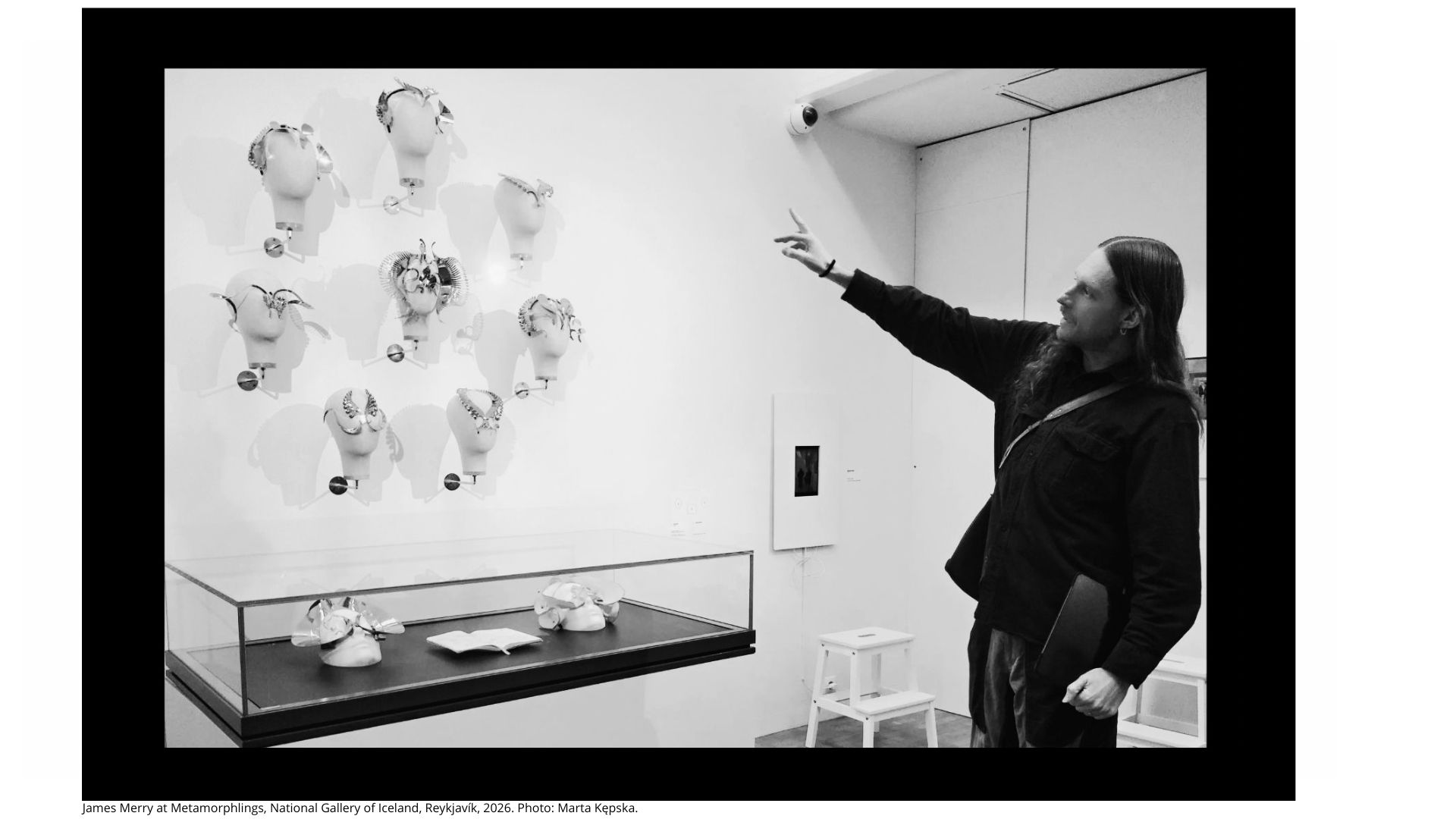
At the entrance to Metamorphlings at the National Gallery of Iceland in Reykjavík is Green Man – the first mask James Merry made for himself. The earlier ones had been created with other people in mind. During the Artist Talk, Merry describes it as the „cover” of the exhibition and says that, of all the works gathered here, this is the one that feels most like him.
It was made for a portrait by British photographer Tim Walker, but the story of the mask begins much earlier – with Merry’s childhood in south-west England.
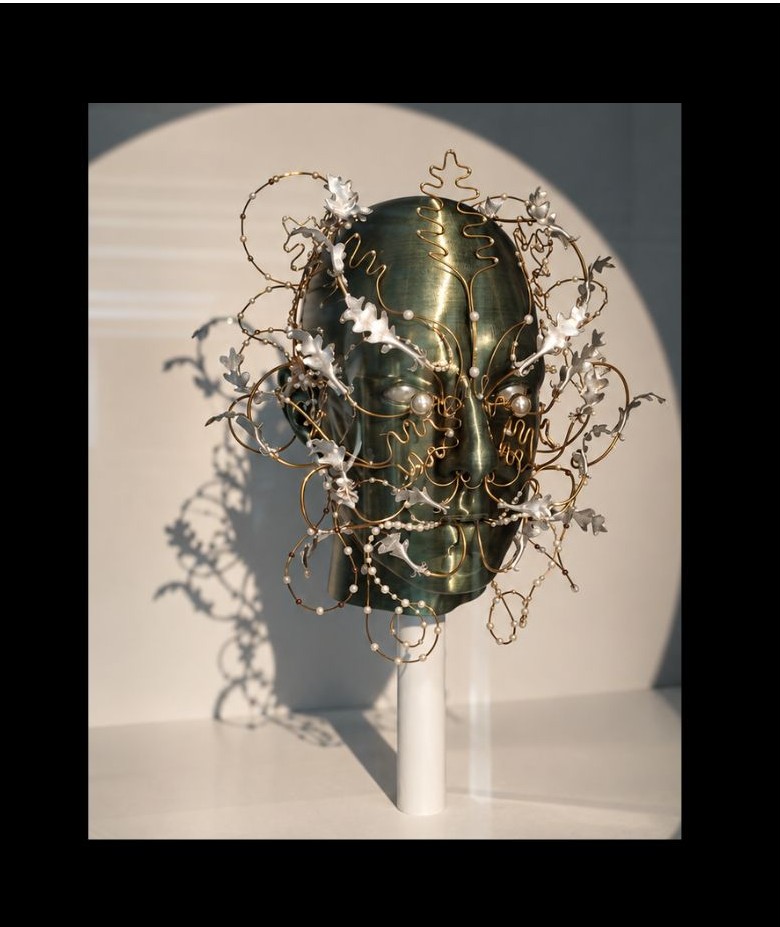
His father was a clergyman, so James spent a great deal of time in churches. High above him, he would see carvings of the Green Man – a human face with leaves, often oak, growing from its mouth and cheeks. The motif, found throughout European architecture, fascinated him as a child. He saw in it a figure suspended between dying and being born: a human face from which vegetation does not simply grow, but seems almost to burst out.
Years later, he returned to that image in a mask of his own. Its elements run around the nose and mouth, close to the teeth. The form does not sit on the face like decoration. It looks as though it is emerging from beneath the skin.
That distinction matters to Merry. He is not interested in the traditional idea of a mask that conceals a person and replaces one face with another. His objects remain permeable. They enter the mouth, wrap around the nose, follow the cheekbones and expand around the head. The face remains visible, but its boundaries no longer end where the human body does.
Merry says that, as he works, he looks for the point at which he can no longer clearly name the form taking shape. Is it a plant, a sea creature or a fragment of human anatomy? Once the answer becomes obvious, he knows he has gone too far. What interests him most is transformation while it is still incomplete.
ICELAND, LONGING AND EMBROIDERY
Merry moved to Iceland in 2009. Before that, he studied ancient Greek literature and history at Oxford. He grew up in a home where the past was a tangible presence: his mother is an archaeologist, and family outings took them to small museums and archaeological sites.
After moving to Iceland, he wrote poetry and made illustrations to accompany it. Even in those early drawings, human anatomy merged with botany. Bodies turned into plants, while plants began to resemble organs.
A few years later, Merry was living in New York. At the talk in Reykjavík, he recalls that period without much affection. He did not like being there and missed Iceland intensely.
He began taking old sports sweaters and embroidering Icelandic plants over them.
The logos of mass-produced clothes became overgrown with moss, stems and flowers. He made thirteen or fourteen of these sweaters. While selling them in New York, he spent a week sitting in a shop window embroidering one of them. He wanted to make visible something that usually disappears in the finished object – the time required to make embroidery by hand.
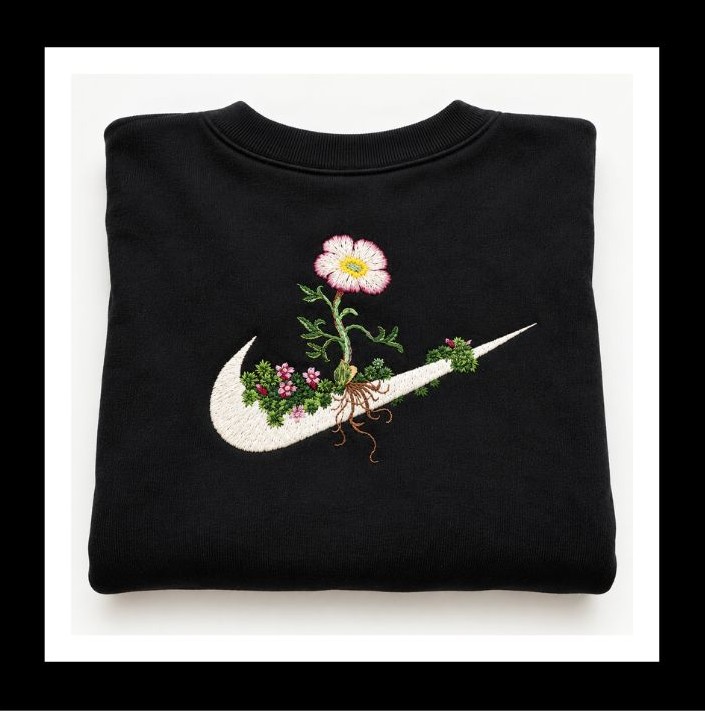
Metamorphlings, 2026. Photo: Marta Kępska.
He had known the needle since childhood. He remembers embroidering a bookmark at school when he was eight or nine. At university, he made embroidered gifts for friends, stitching portraits of their favourite musicians onto white shirts, including David Bowie.
Today he works with metal, silicone, resins, casting and 3D printing, but he still calls himself an embroiderer. Even techniques far removed from traditional needlework remain, for him, variations on the same activity.
Wire can become thread suspended in space. A sheet of metal can be treated like fabric. A line can leave a flat surface and travel around the face.
The organisms Merry observes around him enter his work just as naturally. In spring, he notices birds. In autumn, when mushrooms appear, he begins looking closely at their forms. Orchids, jellyfish, moths, feathers, stingrays, fish skeletons, bones and the gills beneath a mushroom cap all recur in later works.
He is not interested in reproducing a plant or animal literally. Merry breaks natural forms down into lines, surfaces and structures, then brings them onto the human body.
BJÖRK. BEFORE THE FIRST MASK
Merry’s name has long been associated with Björk, but masks entered their collaboration relatively late. By the time he made the first one for her, they had already been working together for around six or seven years. He recalls with some amusement that he is now often described as a „mask maker”, even though for a long time making masks was something he did in the evenings alongside his day-to-day work.
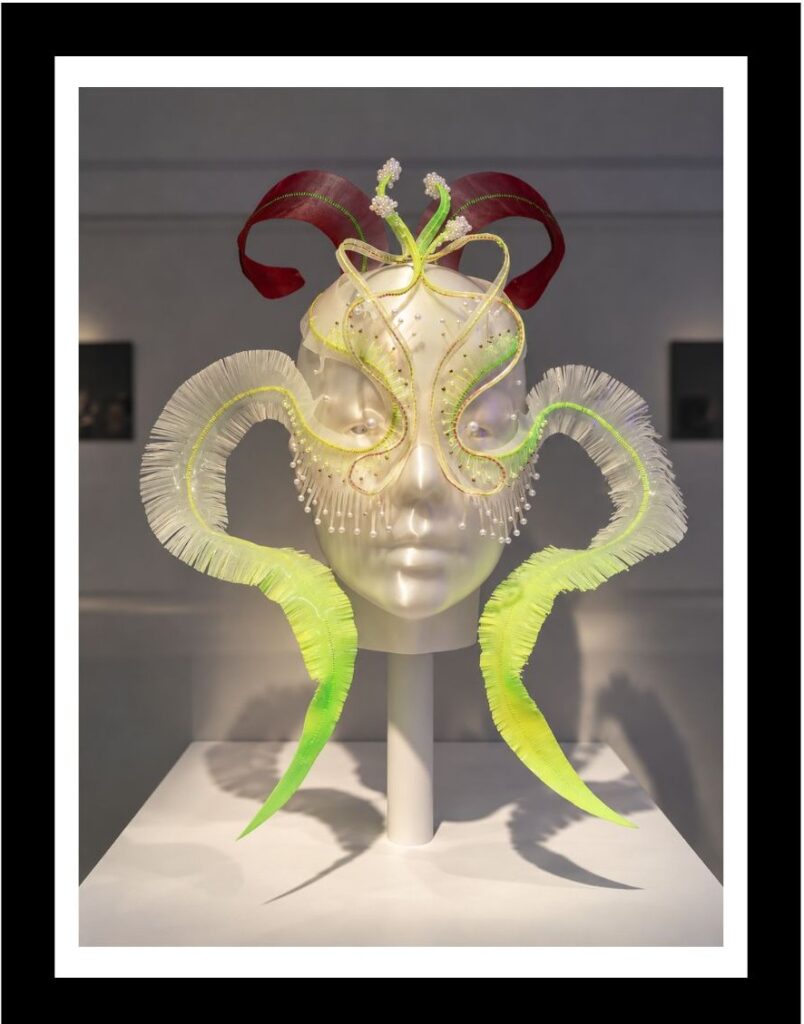
Photo: Marta Kępska.
The first appeared during the Vulnicura period. Embroidery fitted naturally into the album’s visual language of wounds, loss and stitching things back together. Merry saw a place within it for a technique he had previously developed largely through his own projects.
The mask itself came about almost by accident.
It was Björk’s birthday. During preparations for a shoot in Iceland, a piece of lilac latex left over from her costume was lying around. Merry took it and began working on what was initially intended to be a piece for the chest. At one point, he put his face through the material. Then he added holes for the ears.
That was the beginning of a series of masks he had never planned to make.
During the Vulnicura tour, new ones emerged in the rhythm of concerts and travel. Merry remembers hotels, rented apartments, cities and the number of days remaining before a performance.
He made one of the masks in Slovakia. He ran out of the hotel to find pink fabric, used a tiny hotel iron, and when time ran short, continued embroidering a yellow section in the taxi on the way to the concert. The neon thread belonged to the album’s colour palette and glowed under ultraviolet stage lighting.
The mask was no longer simply an object to be examined at close range. It had to respond to light, movement, the distance between the stage and the audience, and the body of the person wearing it.
EMBROIDERY MOVES INTO SPACE
At some point, Merry wanted an embroidered line to leave the fabric and hang in front of the face. Thread could not do that. Wire could.
The loops he knew from embroidery began to take shape in three dimensions. Merry still thought of the process as embroidery, only without fabric.
During the Utopia period, the materials changed as well. Silicone facial prosthetics appeared. Merry would first sculpt the form in clay, then make a mould, pour the silicone and apply further layers of colour by hand. The finished pieces were attached directly to the skin.
One form entered the mouth and travelled towards the nose. Others spread around the cheeks and forehead. Wire allowed Merry to retain the characteristic line of embroidery even as the material and construction changed completely.
The work also expanded to include musicians performing with Björk. For the flute players, Merry designed masks inspired by feathers, mushrooms, circles and ways of measuring time.
A SINGLE SHEET OF METAL
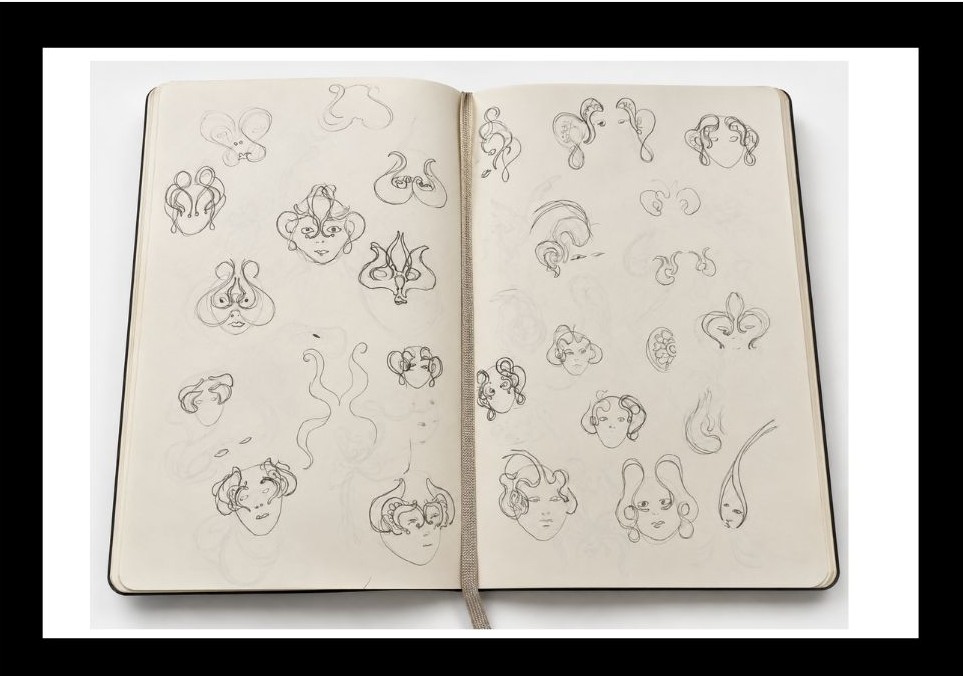
When Merry began working more intensively with metal, he adopted a rule that still governs most of these pieces: the entire form should emerge from a single sheet.
He does not want to solder separate sections together. Joining two pieces immediately reveals the intervention of the maker. An object cut and formed from a single piece, by contrast, can resemble bone, cartilage or an organism that has developed out of its own structure.
He often begins with a square measuring 20 by 20 or 30 by 30 centimetres. Everything that will eventually unfold around the head has to fit within that flat surface.
Merry makes dozens, sometimes hundreds, of paper prototypes. He then moves on to heavier card and finally to metal. For organic forms, he prefers a hand saw. He reserves laser cutting for patterns that require repetition and mathematical precision. Hand cutting, he says, is more like handwriting.
Metamorphlings, 2026.
Photo: Marta Kępska.
The same principle underlies two masks made for Tilda Swinton for the 77th Venice International Film Festival in 2020, when the actress received the Golden Lion for Lifetime Achievement.
The requirements were different from those of Björk. For Björk, a mask had to remain secure during a performance while leaving the mouth free for a microphone. Swinton, by contrast, needed an object she could raise and lower while appearing on the red carpet, while also being able to cover her mouth with it.
Merry used the stingray, a motif already present in his earlier work. In Venice, he found its historical counterpart in depictions of stingrays carved into the wooden pillars of the Rialto market.
BETWEEN HAND AND SCREEN
Around 2017, Merry became interested in the face filters beginning to appear online. His physical masks were one-off objects, and he had no interest in producing them on a mass scale. In augmented reality, however, the same form could be „worn” by many people.
Over time, a dialogue developed between the screen and the studio. A physical object could be scanned or photographed, transferred into 3D software and digitally transformed, with the resulting solutions later feeding into another handmade work. A form conceived on screen could enter physical material, while discoveries made by hand could travel back into the computer. Among the works shown in the exhibition is Utopia Silicone AR filter from 2020.
When Instagram discontinued access to such filters, Merry kept a device running the appropriate version of the software and prevented it from updating. Digital works had begun to require their own methods of preservation.
The principle of a single surface also applies to his digital modelling. Merry begins with a circle or a square, bending and twisting it rather than attaching additional elements. Digital work does not make the process faster. During the talk, he says it can take him around ten times longer than working by hand.
EIGHTY-SIX
It was only during the pandemic that Merry decided to catalogue his masks. He assumed he had made around thirty.
The final count was closer to eighty-six.
Seeing them together allowed him to recognise recurring families of forms: orchids, jellyfish, moths and insects, stingray skeletons. He identified five such groups and created a final metal version for each, jokingly describing them as their „final boss evolution”.
Many of the earlier masks did not survive. They were made quickly for performances, travelled extensively and were worn. The metal versions brought to a close a phase that had developed over years.
Metamorphlings, 2026. Photo: Marta Kępska.
BEYOND THE MASK
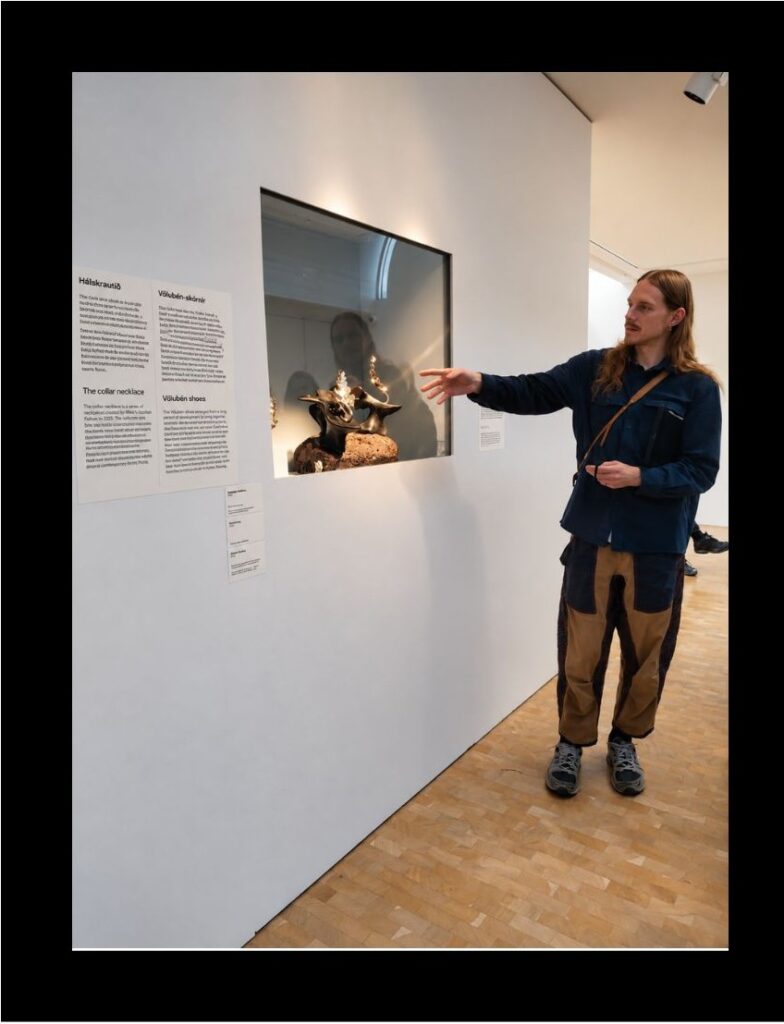
Merry’s work eventually began to move beyond the face. For Björk’s next album, he created a pair of wooden shoes inspired by historical footwear he had seen at the National Museum in Dublin. Their elevated form reminded him of bones and teeth, but the choice of materials was equally deliberate: he wanted the objects to feel as though they could have belonged to another period, without plastic or visibly modern elements.
The shoes were carved from solid birchwood, stained with charcoal and polished with beeswax. Despite their sculptural appearance, they were made to be worn. Merry recalls being surprised that Björk managed to keep them on for around eight hours during a shoot, even while holding an extreme crouching position.
He then extended the same thinking to other parts of the body. A neckpiece transformed the neck into a structure resembling the gills beneath a mushroom cap. Rings followed, developed with a bronze foundry near the rural part of England where he grew up. Merry describes this period as a conscious move away from masks towards other forms of adornment. Yet the underlying idea remained the same: an object belongs on the human body, altering its shape or allowing it to merge with something drawn from the natural world.
The shoes also contain an Icelandic element. At the back, Merry incorporated material from a Carbfix core sample. During the Artist Talk, he explained that the white mineral deposits in the sample were formed through the underground mineralisation of captured carbon dioxide.
THE BODY HAS ITS OWN MAPS
Another series began with an interest in hair pigmentation. During his research, Merry came across the lines of Blaschko – patterns related to cellular development during the embryonic stage, normally invisible on human skin but revealed by certain skin conditions.
He began looking through medical documentation. The lines run along the limbs, form patterns across the back and chest, and spiral around the head.
Only then did he realise that some of his earlier masks had intuitively followed the face in similar ways.
Anatomy that had previously remained hidden beneath the surface became a pattern placed on the outside of the body.
ARCHAEOLOGY RETURNS
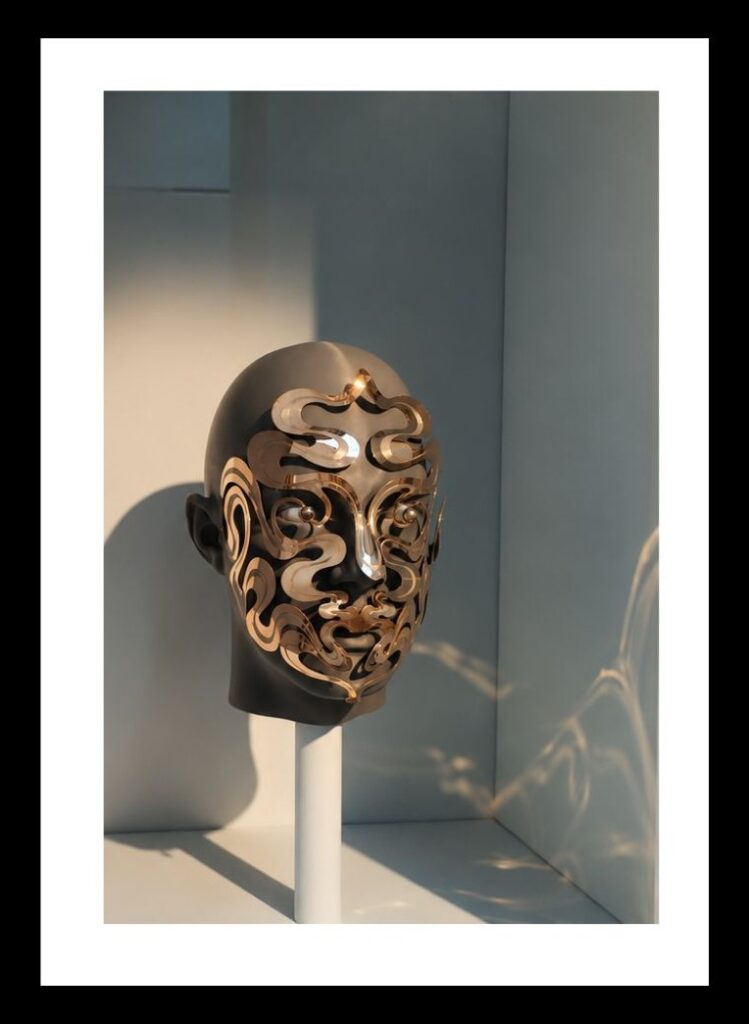
Photo: Marta Kępska.
In recent years, archaeology has taken up an increasing amount of space in Merry’s work. He is particularly interested in La Tène art and the European Iron Age. He visits archaeological sites and small museums in England, studies objects, photographs them and reads about the places from which they came.
He is particularly drawn to south-west England, where he grew up and where traces of ancient places of worship survive. He is interested in the period when, following the Roman conquest, local deities and traditions encountered Roman culture. Written sources do not allow the entire belief system to be reconstructed, and the meaning of many objects remains open to interpretation.
Merry works within the space left by that uncertainty.
Sulis, from 2025, leads back to Bath, home to the Roman bathing complex and the cult of a deity associated with its thermal springs. The bronze structure evokes rising steam and the energy beneath the earth’s surface. The hand-cut and engraved metal is finished with silver.
In Taranis, also from 2025, the starting point is Iron Age headgear, including an example found at Wanborough in Surrey. The wheel motif found on such objects has sometimes been associated with Taranis, the Celtic god of thunder, although that attribution is not archaeologically certain. Merry retains that ambiguity. The swirling brass elements can suggest both the movement of celestial bodies and the forms of storm clouds.
A FACE THAT MEASURES TIME
Atenovx combines a mask with a calendar.
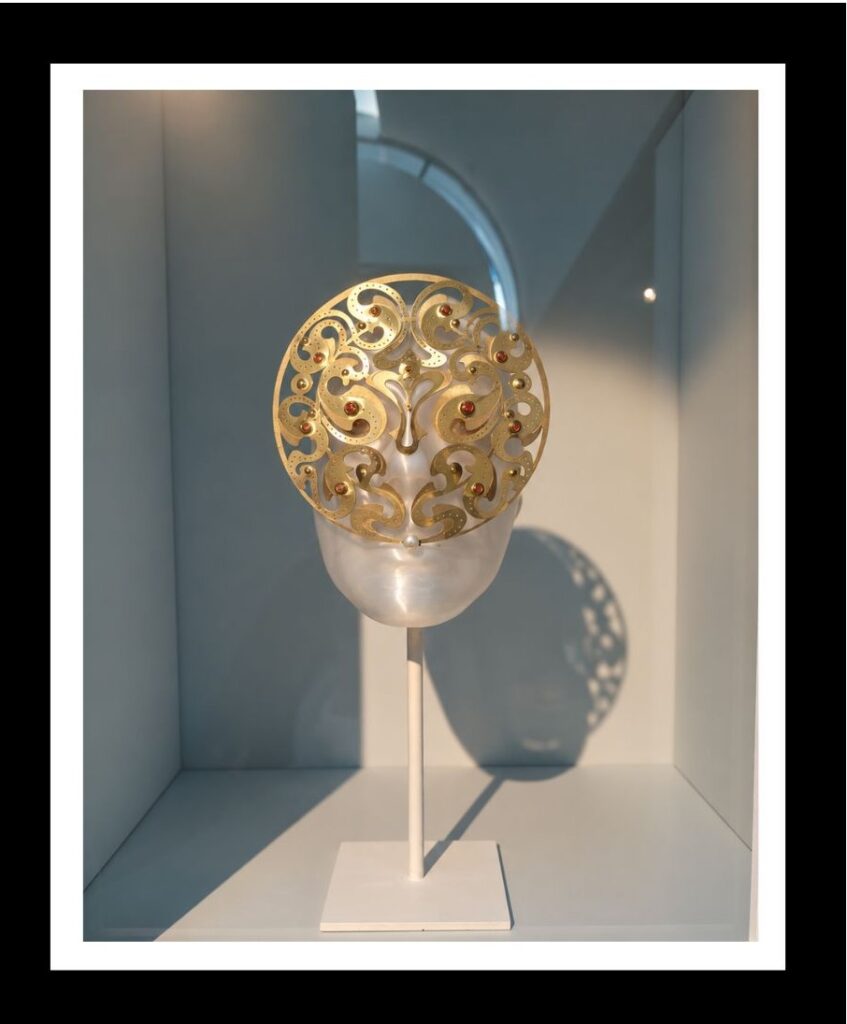
Photo: Marta Kępska.
Holes running around the face correspond to individual days of the year. A small pearl can be moved to mark the passage of time. Twelve swirling forms correspond to the months of the Julian calendar. The equinoxes sit at the eyes, the winter solstice at the forehead and the summer solstice at the mouth.
Here Merry draws on ancient European objects in which ornament, observation of the sky and the measurement of time existed alongside ritual functions. His references include La Tène art and the Dôme aux Dragons from Roissy in France. The title Atenovx comes from the Coligny calendar, a surviving record of the Gaulish system of timekeeping.
The mask is made from solid brass, red onyx, a freshwater pearl and a wax bead.
Merry is not reconstructing an archaeological artefact. He takes part of an ancient system of signs and turns it into a contemporary object made for the human face.
NOT BREAKING THE SPELL
For all his interest in archaeology, Merry approaches the history of masks themselves with surprising caution.
During the Artist Talk, someone asks him about research into their ritual significance. Merry says that he owns books about masks but deliberately leaves some of them unread. He will normally research a subject that interests him in great depth. Here, he chooses to keep a boundary.
He does not want to „break the spell”.
Masks, however, had been part of his life long before he began working with Björk. As a child, he and his sisters had a box of paper masks. They played with them until they fell apart. His favourite was an old woman wearing a cloth hat.
Today, he is most interested in objects connected with ritual and ceremony – things designed to be worn and used. He admits that this is one reason he was reluctant for a long time to exhibit his own work. An object placed behind glass loses the movement and the body it was made for.
SIX MONTHS BEFORE THE EXHIBITION
Six months before Metamorphlings was due to open, Merry set an alarm on his phone. It marked the moment when intensive work on the exhibition was supposed to begin.
Soon afterwards, he slipped on ice and badly broke his right arm. The bone snapped in half. His arm was immobilised for three or four months, and for a time the exhibition itself was in doubt.
A friend helped him with tasks including polishing metal. Merry also admits that handing parts of the work over to other people does not come naturally to him.
During the talk, someone asks about assistants.
„Do you have people who help you make the work?”
„No.”
A moment later, he adds that he probably should.
He does, of course, use specialist services. He may make a sculpture himself and have someone else cast it; for wooden objects, he works with someone who has the necessary skills. But he keeps the core of the process in his own hands.
He does not design a finished form and then simply execute it. The form emerges through the act of making.
Paper is folded, cut and discarded. Metal behaves differently from what he expected. Sometimes a piece falls to the floor and, in its new position, suggests the solution. Merry is reluctant to prepare detailed designs in advance, even when a costume designer or director wants to know exactly what they will receive.
EMBROIDERY, METAL AND ARTIFICIAL INTELLIGENCE
During the talk, another question concerns the future of embroidery in a world of artificial intelligence, machine design and 3D printing.
Merry does not see new technologies as the end of handcraft. He points out that even the most technically advanced work in fashion still depends on many pairs of human hands. He describes embroidery as something almost primal.
It also has very practical advantages. Embroidery strengthens material. Embroidered masks are light, durable and relatively easy to repair. Metal can corrode or bend.
In recent years, Merry has been learning goldwork – a traditional embroidery technique in which metal threads are laid across the surface of the fabric and secured with small stitches. The technique reminds him of a circuit board.
His own approach to embroidery has been experimental from the beginning. He has embroidered wool into latex and pushed thread through plastics; when the material resisted too much, he used pliers, and sometimes even his teeth. He also talks about the idea of using conductive thread that could deliver an electric shock to someone attempting to touch the work.
METAMORPHLINGS
In a single gallery, Metamorphlings brings together works made under very different circumstances: for the stage, for film, for a photographic portrait, for a particular person, or simply out of curiosity about a material. There is embroidery, wire, silicone, metal, wood, resin, 3D printing and digital work. There are projects for Björk, Tilda Swinton and Iris van Herpen. The National Gallery of Iceland has assembled more than eighty works spanning the past decade; it is Merry’s first museum retrospective.
Among so many objects, it would be easy to lose sight of the person who made them. The Artist Talk does the opposite.
The Green Man glimpsed high in a church returns. So does a bookmark embroidered at school. White shirts stitched with portraits of musicians for friends. Icelandic plants embroidered onto old sweaters in New York. A mask finished in a taxi before a concert. Paper prototypes. Mushrooms appearing in autumn. A medical photograph. A piece of bone. An object found at an archaeological site.
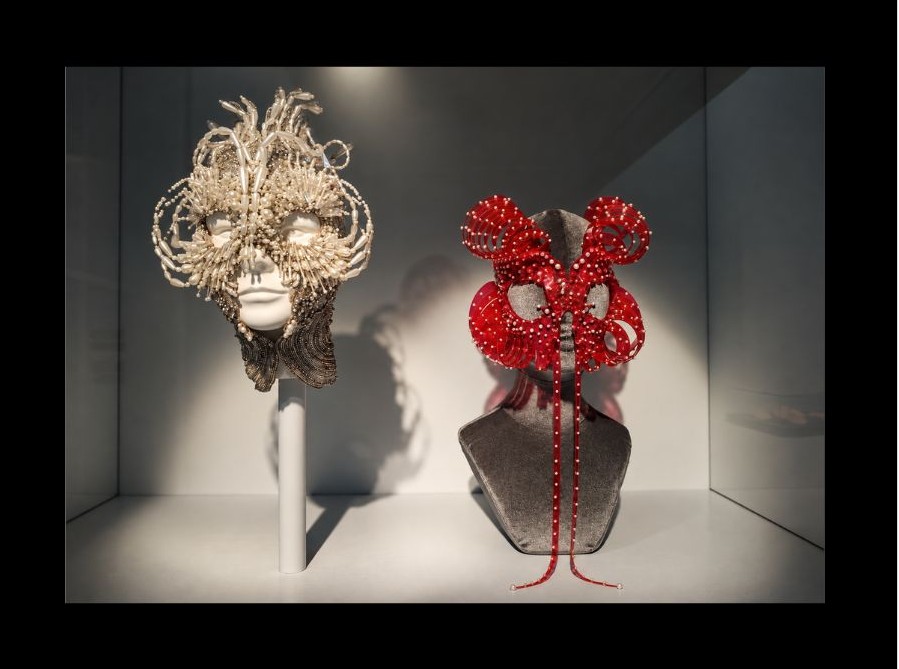
Merry says that these days he looks less and less to the work of other artists for inspiration. He is more interested in a strange bone, an organic form, a flower or an archaeological object. He collects images, reads, visits places and explores museums.
Over the years, the materials and tools have changed. Embroidery gave way to wire, silicone and metal; 3D scanning and augmented reality entered the process, followed by archaeology and ancient systems of signs. Yet a similar moment keeps returning in Merry’s work: the body begins to resemble something that no longer belongs entirely to the human. A leaf, a bone, a wing, a mushroom or a fragment of a marine organism is not simply placed on the face. It seems to grow from it.
Seen in this context, the Green Man at the entrance no longer feels like an arbitrary choice. A face overgrown with leaves, remembered by a boy who spent much of his childhood in English churches, returned years later as the first mask he made for himself. Now it opens his first museum retrospective.
FROM REYKJAVÍK TO BIELSKO-BIAŁA
Metamorphlings, curated by Pari Stave, opened in Reykjavík at the end of May alongside Björk’s echolalia. Now the two exhibitions are heading in different directions.
While Merry’s retrospective remains in Reykjavík, echolalia is moving to Poland. From 2 October, the exhibition will be presented in Bielsko-Biała, where Ancestress and Sorrowful Soil will be joined by the premiere of Nerve Bloom, created by Björk in collaboration with Polish artist Natalia Kleszczewska.
──────────────
JAMES MERRY – METAMORPHLINGS
31 MAY – 18 OCTOBER 2026
National Gallery of Iceland, Reykjavík
Curator: Pari Stave
• Björk | James Merry – Exhibition Catalogue
BJÖRK – ECHOLALIA
Bielsko-Biała, Poland
From 2 October 2026
Ancestress · Sorrowful Soil · Nerve Bloom
If you found this article valuable and would like O Zmierzchu i Świcie to continue publishing independent editorial content, you can support the Magazine Development Fund.
For more information, visit ABOUT THE MAGAZINE .
Content published in O Zmierzchu i Świcie is intended for educational and general informational purposes. It does not constitute medical, psychological or nutritional advice and is not a substitute for consultation with a physician or another qualified professional.