“We were the only people who never saw the Beatles,” George Harrison once said. Published in October 2026, The Third Eye: Early Photographs brings together photographs he took between 1963 and 1969. They capture life on the road, private moments with his bandmates, encounters with friends and people he met along the way. Harrison, whose face was known to millions, was just as comfortable on the other side of the camera.
Before Everyone Knew His Face
In the autumn of 1963, twenty-year-old George Harrison made his first visit to the United States. Travelling with his older brother Peter, he went to Illinois to visit their sister Louise. Towards the end of the trip, he also reached New York, where he could still wander among the tourists at the Empire State Building without attracting much attention.
A few months later, everything had changed. In February 1964, the Beatles made their American television debut, and their arrival sparked extraordinary public excitement. Moving freely through streets, airports and hotels became increasingly difficult.
Harrison often carried a Pentax camera.
One photograph from this period shows Paul McCartney shaving in the cramped bathroom of a Pan Am aircraft during the band’s first trip to New York. There is no stage outfit or carefully arranged portrait. Just a young man going about an ordinary routine on a journey that would soon become part of music history.
In another image, John Lennon is trying to retrieve a guitar pick that has fallen inside an acoustic guitar. Ringo Starr flashes a broad grin. Elsewhere, Paul and John appear between George’s fingers, which are held up close to the lens, making their figures seem small enough to fit between them.
These photographs reveal Harrison’s delight in experimenting with the camera. He was interested not only in his friends’ faces but also in what he could do with scale, perspective and the way an image is perceived.
A scene preserved in the documentary The Beatles: The First U.S. Visit, with footage also featured in Beatles ’64, captures the spirit of those years particularly well. George is photographing Ringo while Ringo films George. Each has a camera pointed at the other.
Two friends recording the same moment from opposite sides.
Harrison’s photographs often emerged from such unguarded encounters. He did not need special access to the places where the Beatles spent their time. He was one of them.
Everything Looks Different
For years, the press referred to Harrison as “the quiet Beatle”. Yet his photographs reveal a man whose interests extended far beyond the reserved public persona associated with him.
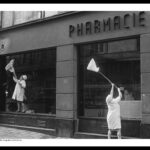
He was drawn to people, their gestures and their surroundings. He photographed street workers in Paris, people he encountered in India, friends, landscapes and himself.
He enjoyed experimenting with wide-angle lenses and the fisheye effect, using coloured filters, altering perspective and distorting familiar forms.
“I’ve got this fish-eye lens now-everything looks mad through it!” he remarked.
Among the photographs are self-portraits taken during his travels. In Tahiti, Harrison photographed himself with something resembling a strand of seaweed. In India, he experimented with a wide-angle lens in front of the Taj Mahal, trying to include both himself and the surrounding architecture within a single frame.
A faithful reproduction of reality was not always what interested him.
As he once explained:
“I like cameras because you can see things in a different way, and you can make things look how they feel instead of how they are.”
His interest in photography continued long after Beatlemania.
In an interview with Ailsa Chang for NPR, his wife recalled walks that could last far longer than anyone had anticipated. George would stop repeatedly to take photographs. Sometimes it was an expansive landscape that caught his attention; at other times, something as small as a grain of sand on a beach.
A long walk with him required some preparation. Olivia joked that it was wise to bring provisions.
Photography also offered Harrison a measure of privacy. At the height of the Beatles’ fame, strangers constantly wanted to see him, touch him or ask him questions. With a camera in his hands, he could decide for himself where to direct his attention.
“And I think that camera really becomes a barrier, a shelter,” Olivia told NPR.
Behind his own camera, Harrison could, for a moment, swap places with the people who never stopped photographing him.
A Photograph of a Rainbow
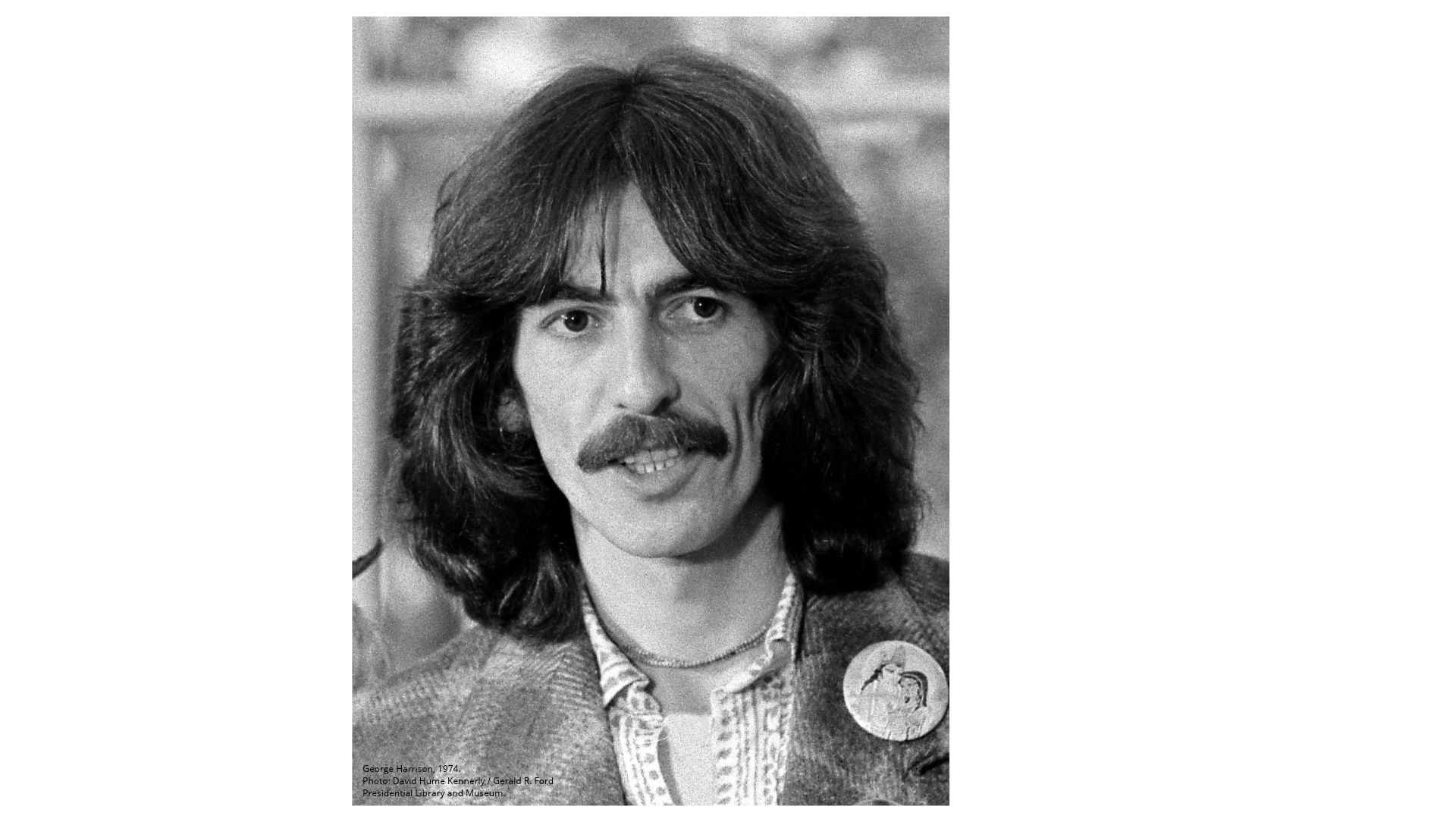
Olivia met George in 1974 while working at Dark Horse Records.
Speaking to NPR, she recalled their first encounter. Harrison parked his car and approached her carrying a photograph and some incense.
The picture showed a garden beneath a rainbow. On the back, he had written a single word:
“Somewhere.”
At the end of the rainbow, George had attached a tiny pin representing the legendary pot of gold.
The photograph remained in the house but eventually disappeared among their belongings. It was rediscovered some forty years later.
During the interview, Olivia reflected on something she had not previously considered: the first thing George had given her was a photograph.
The camera remained part of their everyday life. Sometimes she would wake in the morning to discover that her husband was taking her picture.
One of her favourite family photographs was taken in the gardens of Friar Park. Inspired by a book on traditional Russian wooden architecture, George had built a small dacha there. One autumn, he positioned his camera in front of the building and photographed the three of them – himself, Olivia and their son Dhani – sitting on its steps, surrounded by trees in their autumn colours.
Dhani was already old enough to spend a great deal of time with his father, and the two shared a close bond.
It is this family portrait that Olivia remembers as one of the photographs particularly dear to her.
The Boxes Nobody Opened
George Harrison died in 2001. Alongside his recordings and instruments, he left an extensive collection of photographs, slides and private films.
Not everything had been carefully labelled or organised.
At Friar Park, some of the slides were stored in cupboards near the old pantry. The boxes had been stacked so precariously that they almost fell on Olivia as she began going through them.
Other recordings had been stored in much the same way. She discovered tapes of the Traveling Wilburys in an ordinary bag tucked away in a small cupboard beneath the stairs.
George had little interest in organising his past. He preferred to devote his attention to whatever occupied him at the time: music, gardening and new ideas.
The work of organising the family archive became more systematic during preparations for Martin Scorsese’s documentary George Harrison: Living in the Material World, released in 2011.
Going through the material revealed further chapters of his life, including years before Olivia had known him.
The photographs from the Beatles era were especially revealing in this respect. She had not been present on those journeys and was unfamiliar with many of the moments captured on film. Yet she recognised the way of seeing of the man with whom she had spent nearly three decades.
A Third Perspective
In 2023, Paul McCartney published his photographic collection 1964: Eyes of the Storm. Ringo Starr had previously released his own book, Photograph.
Harrison’s pictures offered another perspective on the band’s history.
Even when the musicians were in the same place, each noticed different things. They framed their subjects differently, chose different moments and were drawn to different details. It was this distinction between their perspectives that inspired the title The Third Eye.
Published by Random House on 6 October 2026, the 352-page volume contains more than 200 photographs and stills from private 8 mm films, many appearing in print for the first time.
The material dates from 1963 to 1969, a period when the Beatles travelled the world, performed before ever-growing audiences and gradually lost the freedom of anonymity.
The photographs were selected by Olivia Harrison. The book also includes George’s own comments and contributions from Olivia, Colm Tóibín and George Saunders.
In an interview with People, she acknowledged that many of these images might have remained unseen had she not decided to bring the book together.
The Third Eye reveals Harrison’s curiosity, his appetite for experimentation and his distinctive sense of humour. Alongside photographs of the Beatles are portraits of friends, people encountered on his travels and places he visited.
George photographed a world he knew firsthand – from hotel rooms and aircraft cabins to the streets of unfamiliar cities.
“We were the only people who never saw the Beatles,” he said. Yet he left behind photographs that allow us to see them as he did.
━━━━━━━━━━━━━━━━━━
Sources
Penguin Random House – The Third Eye: Early Photographs
NPR – The Third Eye Presents an Unfiltered View of the Beatles’ Early Years
People – Olivia Harrison on George Harrison’s New Photo Book
Vanity Fair -George Saunders, See Never-Before-Published Photographs by Budding Beatle George Harrison (2026).
If you found this article valuable and would like O Zmierzchu i Świcie to continue publishing independent editorial content, you can support the Magazine Development Fund.
For more information, visit ABOUT THE MAGAZINE .
Content published in O Zmierzchu i Świcie is intended for educational and general informational purposes. It does not constitute medical, psychological or nutritional advice and is not a substitute for consultation with a physician or another qualified professional.