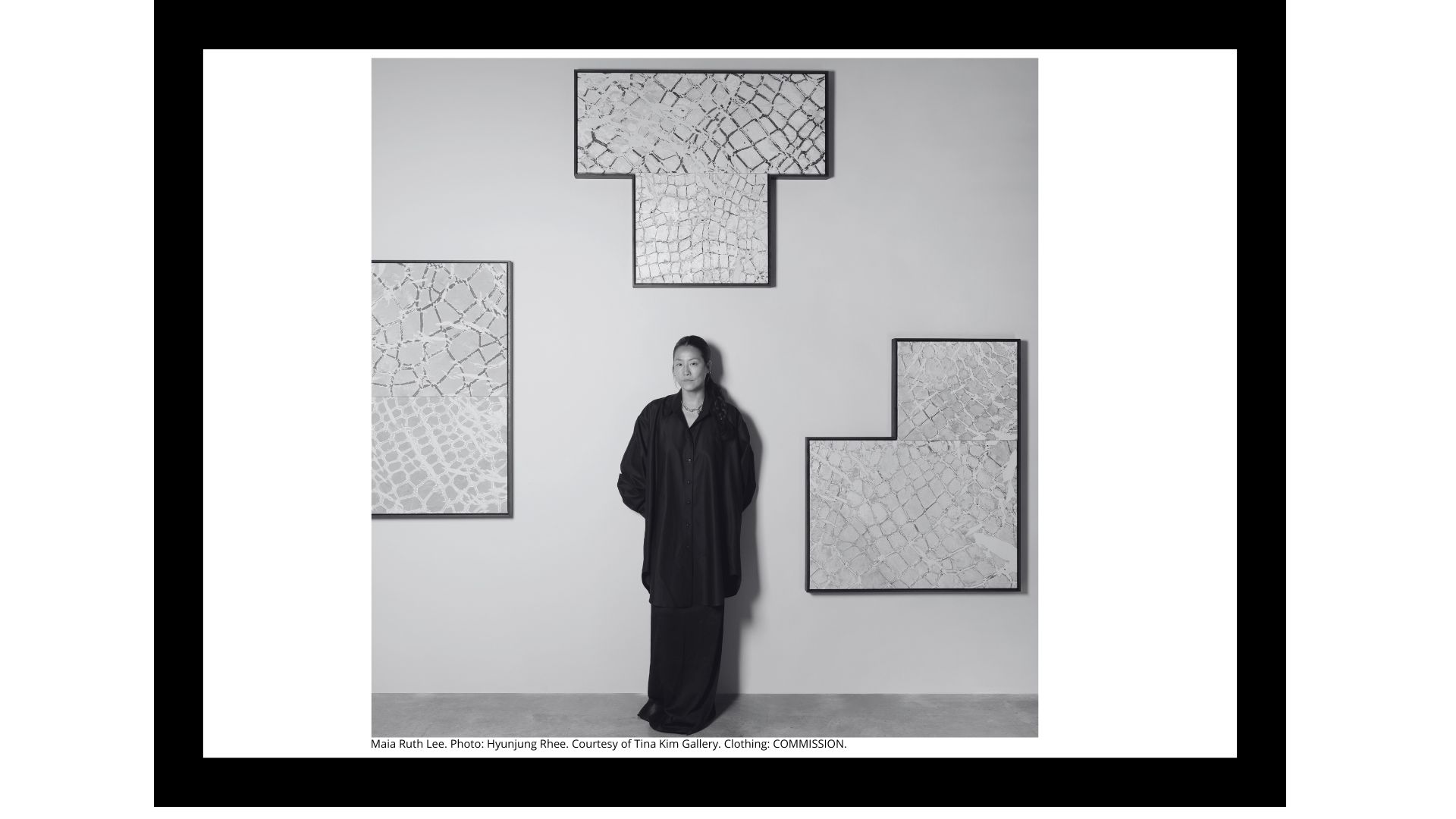
What do we actually take with us when we spend our lives moving from one place to another? Maia Ruth Lee has been responding to this question for more than a decade. With suitcases, ropes, pieces of metal, canvas, family films and signs resembling an alphabet that cannot be read. In her work, migration does not begin at the border and does not end once the luggage has been unpacked. It remains in the way we see, remember and construct our own identity.
At Tribhuvan International Airport in Kathmandu, the luggage of migrant workers returning to Nepal was difficult to mistake for anything else. Cardboard boxes, suitcases and bundles were tightly wrapped in tarpaulin, bedding, tape and rope. Lee had known this sight since childhood. It was only when she returned to Nepal as an adult in 2013 that she began photographing these objects. At the time, she did not yet know what she would do with them. Over the following years, she accumulated hundreds of photographs.
Behind every bundle was a journey, but also the economics of that journey. The luggage belonged, among others, to Nepalis returning from work in the Middle East. It was wrapped repeatedly in part because theft from suitcases at the airport was a real concern. Lee was struck by the peculiar beauty of these objects: each was different, constructed from whatever materials happened to be available, yet together they looked like variations on the same protective form.
Lee would later describe this way of packing as an act of “self-preservation.”
For several years, she collected photographs. She experimented with collage, drawing, painting and zines. None of these forms, however, conveyed the materiality of what she had seen. Eventually, in Nepal, she bought tarpaulins, tape and rope and began reconstructing the bundles. This was the beginning of Bondage Baggage – a body of work that became central to her practice and that she continues to develop today.
The first sculptural works appeared in 2018, made from materials including tarpaulin, rope, tape, luggage, second-hand clothing and bedding. A year later, Bondage Baggage Prototype 4 was included in the Whitney Biennial in New York. The Whitney situated these objects within questions of diaspora, family, economic inequality and the need to protect oneself and one’s belongings. Lee added another dimension: labour – both the work performed far from home and the work required to carry traces of one’s life back to it.
But the story of these bundles begins long before the baggage carousel.
LANGUAGE BEFORE IMAGE
Maia Ruth Lee was born in Busan, South Korea, in 1983. Her parents were linguists and Bible translators. The family moved between Korea, Singapore, Papua New Guinea and Nepal, where Lee’s parents spent years working with the Sherpa community on a translation of the New Testament. The task first required developing a written system for a language that had functioned primarily through oral tradition. Lee therefore grew up in a home where language was never something transparent or self-evident.
It could be dismantled, transferred and written through another system, while translation always left the same question behind: what had been preserved, and what had disappeared along the way?
After finishing school in Kathmandu, Lee returned to Korea and studied painting at Hongik University in Seoul; she also studied at the Emily Carr Institute of Art and Design in Vancouver. In 2011, she moved to the United States and remained connected to New York for more than a decade.
It was there that her experience of constant movement began to form a broader structure. New York was another place of migration, but unlike the previous ones: a multicultural centre and, at the same time, one of the centres of Western power and cultural production. Lee recently told Vogue that it was there, for the first time, that she was able to “completely zoom out and see the bigger picture” – to look at her own history from a distance.
It was then that the photographs of luggage from Kathmandu ceased to be merely an archive of unusual objects.
They began to speak about labour, borders, class, the movement of people, and just how material the need to protect one’s own life can become.
AN ALPHABET THAT DOES NOT NEED TO BE READ
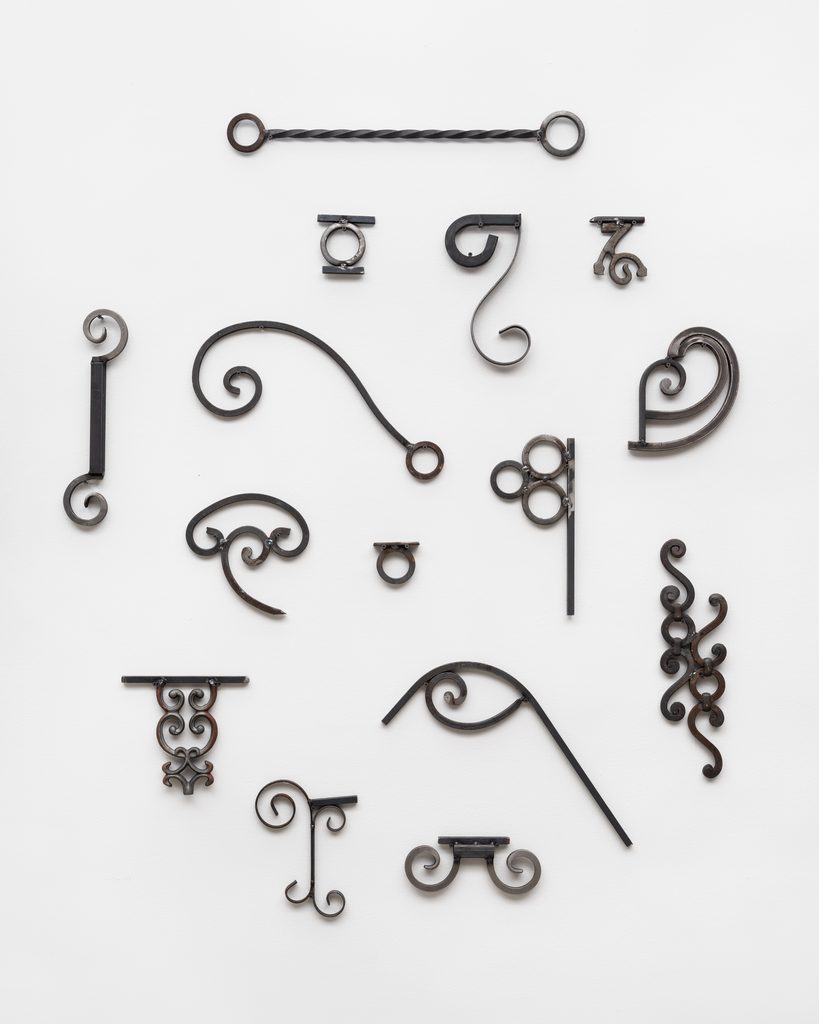
Courtesy the artist and Tina Kim Gallery.
Photo: Hyunjung Rhee.
At the same time, Lee was constructing another language.
Using salvaged fragments of steel window grilles, fences and security barriers from New York, she created signs – glyphs. Elements originally designed to mark boundaries and restrict access, once removed from architecture, began to resemble letters from an alphabet that did not exist. In LABYRINTH, presented at the 2019 Whitney Biennial, they formed a system that appeared simultaneously familiar and impossible to decipher conclusively.
This is an important thread, because in Lee’s practice language repeatedly reaches the point at which it is no longer sufficient.
After moving from New York to Colorado in 2020, she created The Language of Grief. She was working with asemic writing – marks that resemble written language but carry no fixed linguistic meaning. They can be looked at as writing, but cannot be read in the conventional sense. For Lee, this became a tool for working with experiences that language cannot precisely contain: grief, change, loss and memory.
It is hardly incidental that the daughter of translators arrived in her own art at the limits of translatability.
In one interview, she put it plainly: “language is at the core of one’s identity.”
Her work, however, asks what remains when words are no longer enough.
UNPACKING THE SCULPTURE
In Colorado, Lee also returned to Bondage Baggage. This time, rather than asking how to reconstruct a piece of luggage, she began considering how it could be unpacked without losing the memory of its previous form.
She replaced tarpaulin with canvas. She bound the structure with ropes, covered its surface with ink or pigment, then cut the restraints and unfolded the material. Once the sculpture was opened, an image remained: folds, empty spaces left by ropes, pressure marks, stains and traces of a structure that no longer existed.
The object disappeared, but left a map behind.
Lee describes the canvas as an outer layer, a kind of skin of the sculpture. She associates the process of revealing it with catharsis. The resulting paintings do not depict luggage. They are its physical trace – evidence of the material having once been bound.
At this point, Bondage Baggage ceases to be a project about suitcases. It begins to raise a question that can also be asked of people: what remains in the material once that which constrained it has been removed?
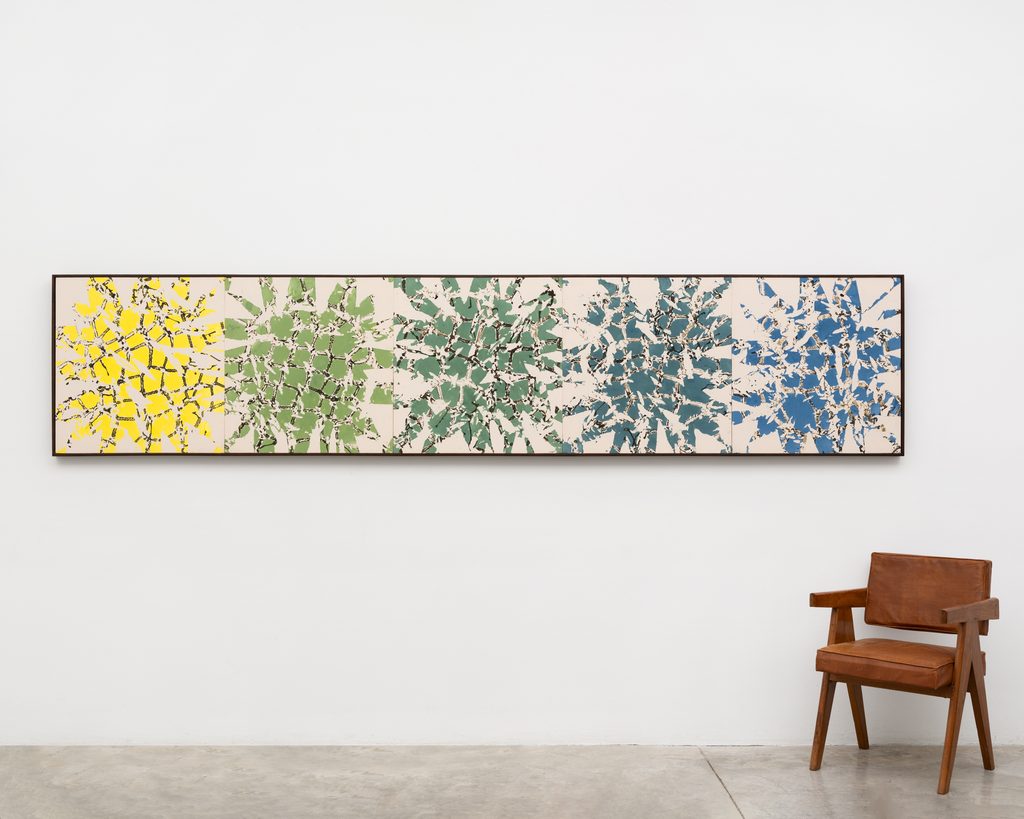
Photo: Hyunjung Rhee.
The 2023 exhibition The skin of the earth is seamless at Tina Kim Gallery extended this idea to the body, territory and borders. Its title was drawn from Gloria Anzaldúa’s Borderlands/La Frontera. Lee has spoken about how reading the book allowed her to see her own work differently: the earth as skin, and the Bondage Baggage sculptures as another skin subjected to pressure, displacement and change.
The accompanying film The Letter combined family footage shot by the artist’s father in Nepal with letters Lee wrote during the pandemic. The private archive did not function as a nostalgic album. It became another material capable of being carried from one time and place into another.
WHAT DO WE COLLECT?
The question returned after the family’s sudden move from New York to Colorado in 2020.
Lee later recalled the exhaustion of continually moving possessions. Luggage, which she had previously approached as an image of other people’s migration, suddenly became something deeply personal. She began asking herself which objects a person chooses to take and what that choice reveals about a life.
In Migrant Reader at François Ghebaly in Los Angeles in 2022, the works took on the roles of atlases, maps, indexes and “readers” of migration. A year later, in New York, Bondage Baggage continued to transform. In 2024, in Once we leave a place is it there at the Institute of Fine Arts, NYU, Lee combined sculptures and painted banners with a Korean ritual table, jesa-sang. The five colours of the banners referred to obangsaek – the traditional Korean system of five colours associated with directions and elements.
Visitors could leave their own offerings, allowing the installation to change over time.
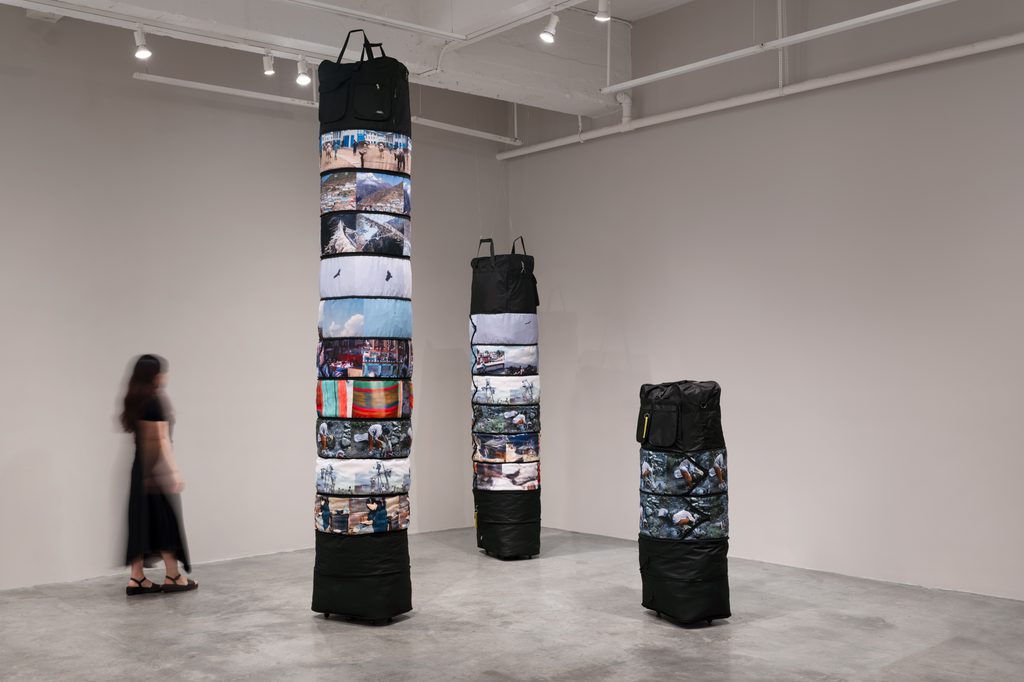
Canvas luggage bags. Courtesy the artist and Tina Kim Gallery.
Photo: Hyunjung Rhee.
The exhibition title – Once we leave a place is it there – was taken from Under Flag by the poet Myung Mi Kim.
Does a place continue to exist once we leave it?
Lee does not answer. She is more interested in the form in which a place continues to travel with a person.
A conveyor belt that never stops. One of the most literal manifestations of this idea was The Conveyor, created for Prospect.6 in New Orleans in 2024.
Lee built a functioning airport baggage carousel. Containers holding personal belongings submerged in mud travelled around it. There was no owner waiting to collect them. The objects returned again and again, repeating the same circuit.
More than a decade after photographing bundles at Kathmandu airport, the artist had returned to the baggage carousel.
Except this time she was no longer observing it from the outside.
She had built her own.
DOUBLE VISION
In September 2026, the story came full circle once again. Double Vision, Lee’s second solo exhibition at Tina Kim Gallery in New York, opened on 10 September and runs through 24 October. Its title comes from Homi K. Bhabha’s The Location of Culture. “Double vision” describes the condition of someone whose perspective encompasses both the place left behind and the place in which they now live.
Lee no longer tries to separate these spaces.
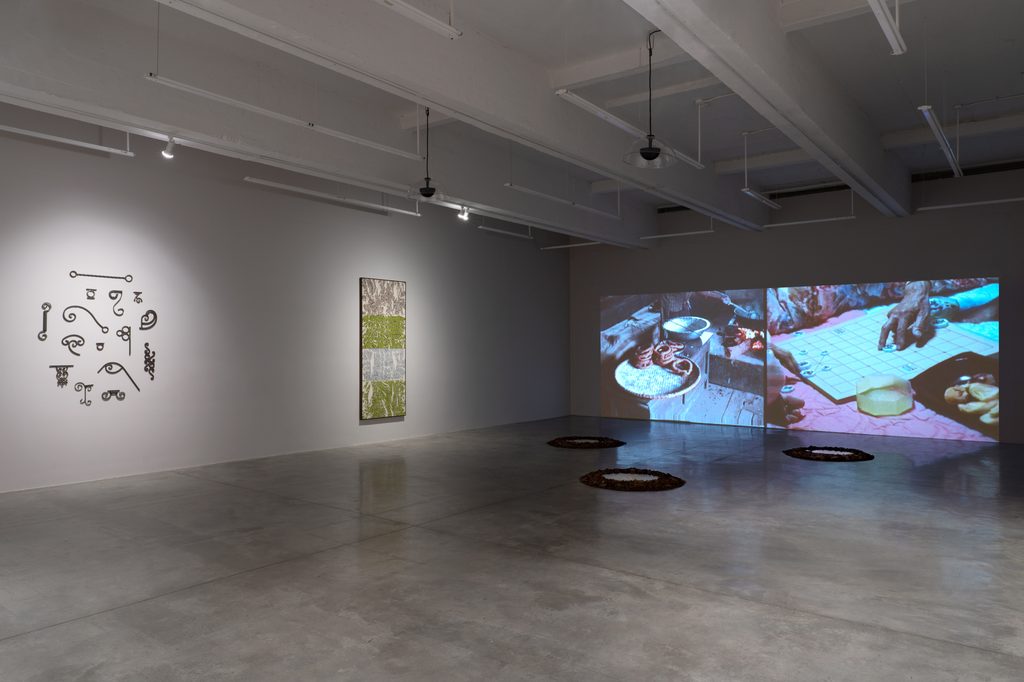
The exhibition brings together new paintings from the Bondage Baggage series, sculptures, latex casts preserving the surfaces of previously bound forms, family films and the steel glyphs first developed in New York. Earlier works are not closed chapters. They return as material for what comes next.
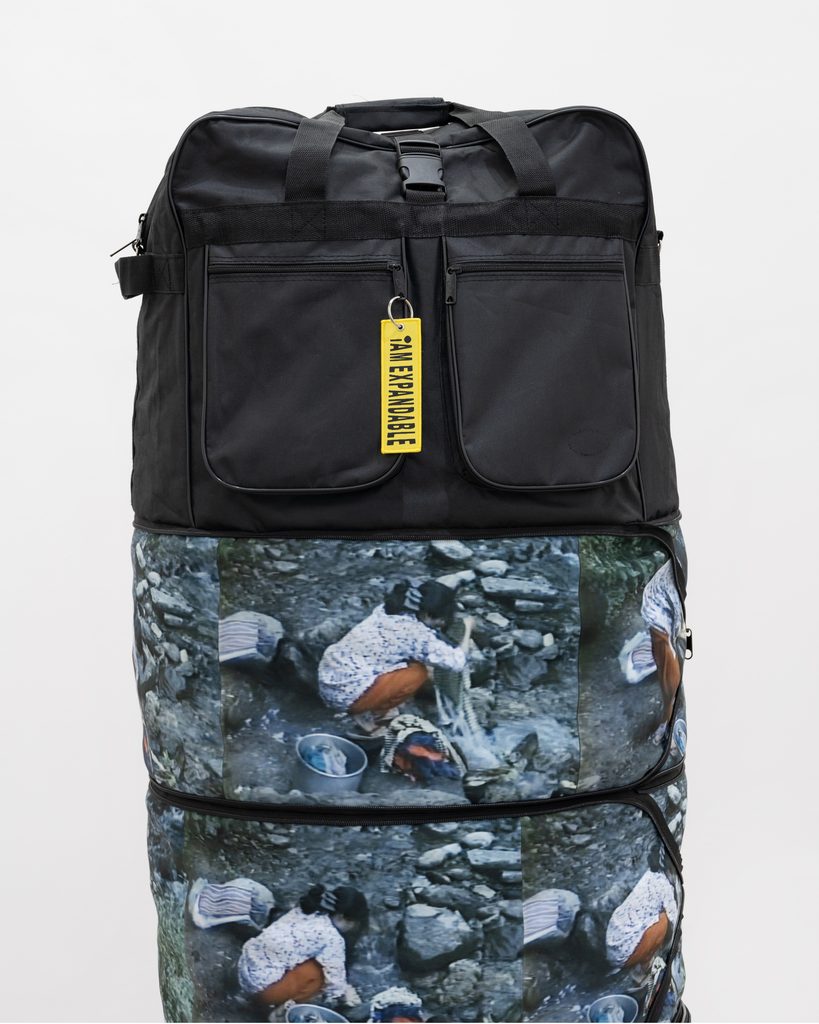
Particularly significant are the large expandable bags known in Korean as 이민가방 (literally, “migrant’s bag”). Lee places stills from family films on their surfaces. When the bags are expanded, the images become visible; when they are folded, parts of them disappear.
“Some parts can be discreet, some parts can be exposed,” Lee says.
Migration also becomes a matter of managing one’s own visibility. A person does not carry every part of their history in the same way. Some parts are shown, others are kept, while still others remain inaccessible even to the person carrying them.
Attached to the bags are yellow tags bearing the words I AM EXPANDABLE. An object can increase its volume to make room for more. It is difficult not to see the human figure within it.
EXPERIENCE
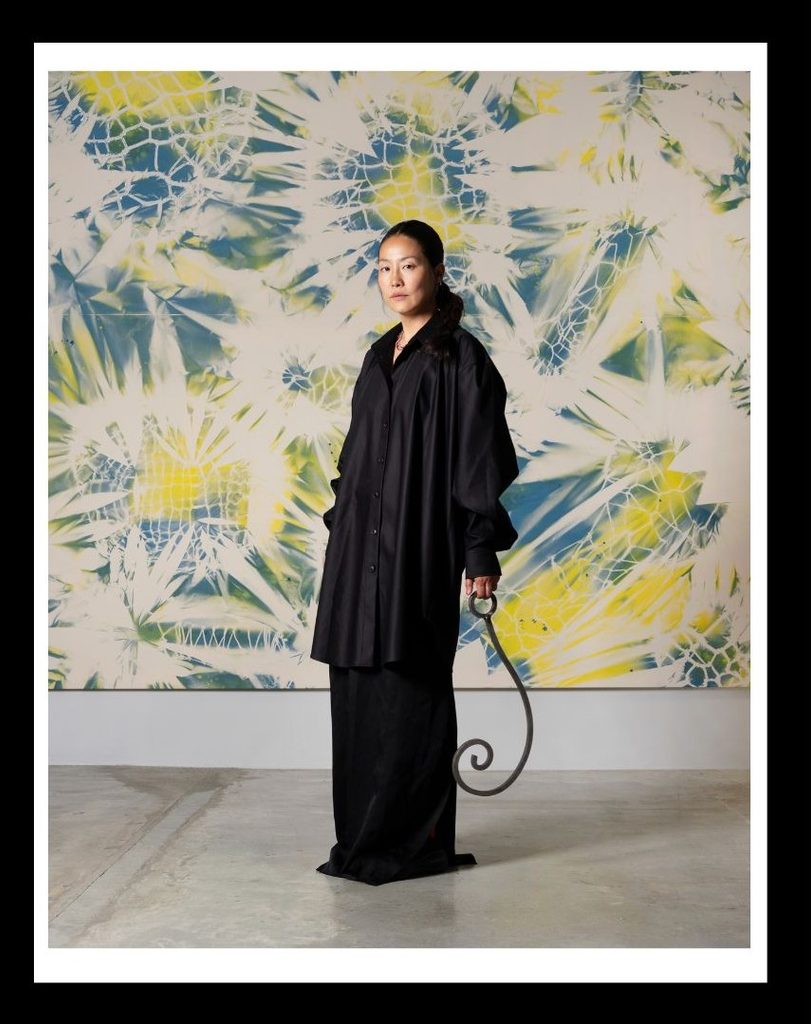
Courtesy of Tina Kim Gallery. Clothing: COMMISSION.
Today, Maia Ruth Lee lives in San Francisco with her husband, artist and photographer Peter Sutherland, and their son. Alongside her artistic practice, she is pursuing further academic work in migration studies. A subject that for years emerged from personal experience has therefore also become an object of academic inquiry.
Her path has taken her through Busan, Kathmandu, Seoul, New York, Colorado and San Francisco. But reducing her art to autobiography would be too easy. Lee uses her own history more like a laboratory in which she tests what happens to language, objects and memory when they are transferred from one system into another.
This is where the connection to her parents’ work becomes most interesting.
They translated language.
She translates form.
A sculpture becomes a painting. A painting – the trace of a sculpture. A steel window grille – a sign. A family film – the surface of a suitcase. A suitcase – a metaphor for the body. A private memory – part of a larger story about migration.
Asked recently whether she herself might be a kind of translator, Lee replied that she had never thought of herself in those terms before. But when she looked at her own practice from that perspective, she recognised the mechanism: a single idea changes form in her work, becoming flat, permanent, latex, painterly or spatial, while remaining part of the same world.
That is why Bondage Baggage did not end with a single work. Lee continues to develop the series today.
The first photographs were taken more than a decade ago. Lee continues to return to them, transform them and unpack them. In an earlier interview, she said that some projects need ten years before it becomes clear what they really are.
Her own remains in motion.
──────────────
MAIA RUTH LEE: DOUBLE VISION
10 September – 24 October 2026
Tina Kim Gallery, New York
525 West 21st Street
Selected sources
Tina Kim Gallery, Maia Ruth Lee: Double Vision, 2026.
Vogue, In Her New Show, Artist Maia Ruth Lee Unpacks a Life in Transit, 2026.
Whitney Museum of American Art, Maia Ruth Lee – Whitney Biennial 2019.
Asian American Arts Alliance, Artist Maia Ruth Lee on Finding Meaning in Rootlessness.
Art Breath, Maia Ruth Lee on Art Reflecting Identity, Roots, Community, on Migration, Memories and Language as Symbols.
Press materials for the exhibition Maia Ruth Lee: Double Vision were provided to O Zmierzchu i Świcie by Hanna Gisel at Tina Kim Gallery.
If you found this article valuable and would like O Zmierzchu i Świcie to continue publishing independent editorial content, you can support the Magazine Development Fund.
For more information, visit ABOUT THE MAGAZINE .
Content published in O Zmierzchu i Świcie is intended for educational and general informational purposes. It does not constitute medical, psychological or nutritional advice and is not a substitute for consultation with a physician or another qualified professional.